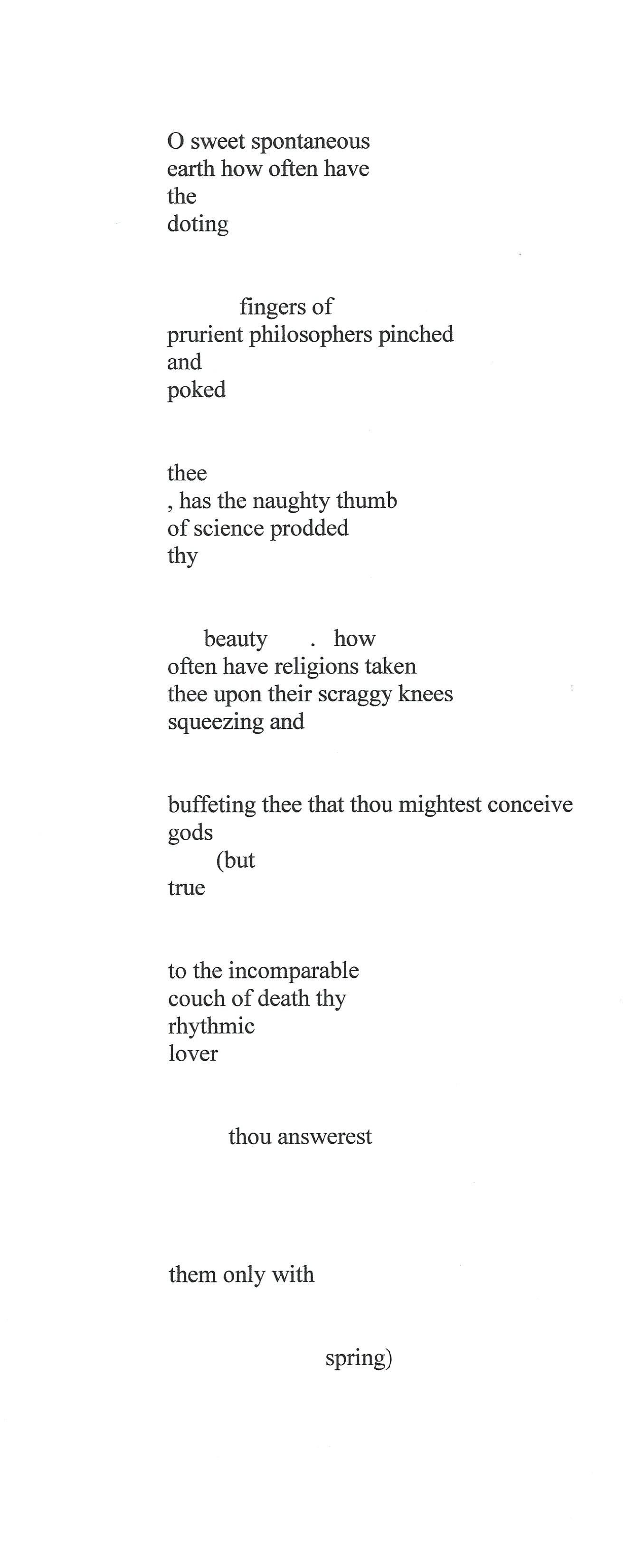
from Tulips and Chimneys (1923)
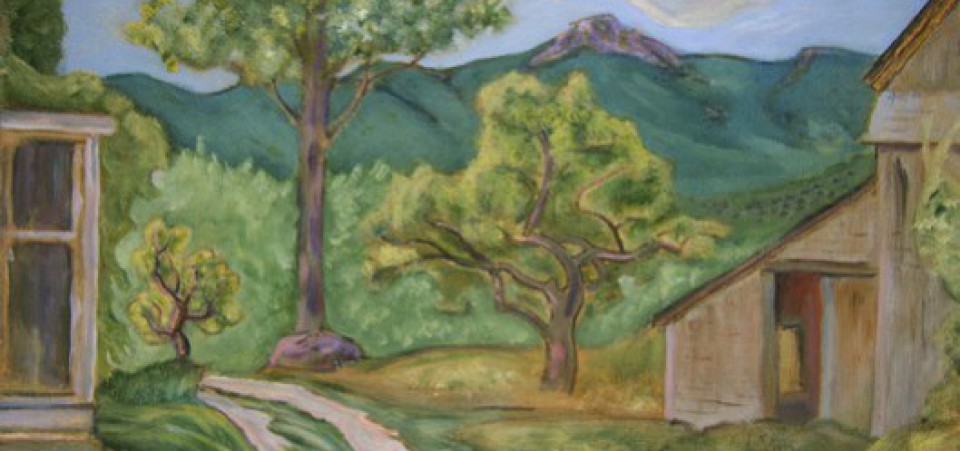
18 Monday May 2015
Posted in EE Cummings
from Tulips and Chimneys (1923)
14 Thursday May 2015
Posted in EE Cummings, Painting
During the Cummings at Silver Lake Celebration, July 10 & 12, 2015, be sure to see the new “Cummings Family Collection” exhibit at the Madison Historical Society, including two paintings by E.E. Cummings recently donated by the Shackford Family.
Among the memorabilia are a pair of Edward Cummings’ red leather sandals from a Julius Caesar costume, photos of the family at Joy Farm, and some of Estlin’s baby clothes.
11 Monday May 2015
Posted in EE Cummings, Madison, Poetry
April was poetry month. In celebration, the Madison (NH) Library set out a “poet tree” where anyone could write out and hang a poem on a leaf. Reading a leaf with one of E.E. Cummings’ poems, a middle school student asked, “Why did he write it like that?”
“Even readers who seldom read poetry recognize the distinctive shape that a Cummings poem makes on the page: the blizzard of punctuation, the words running together or suddenly breaking part, the type spilling like a liquid from one line to the next:
one
t
hi
s
snowflake
(a
li
ght
in
g)
is upon a gra
v
es
t
one
Cummings was not the first poet to use a typewriter, but as this poem shows, he was the first to take advantage of its power to control the exact spacing and shape of every line, and thus to make a poem’s visual appearance as important as its musical rhythms. What looks like a thin trickle of letters becomes, to a reader who has learned Cummings’s tricks, a picture in print: the snowflake “alighting” in a twirl, the severe vertical of the “gravestone.” This playful tinkering with language is the most obvious and appealing sign of Cummings’s originality; as he once wrote, it is “such minutiae as commas and small i’s,in which…my Firstness thrives.”
The Rebellion of E.E. Cummings
The poet’s artful reaction against his father—and his alma mater
by Adam Kirsch
Harvard Magazine
March-April 2005
http://harvardmagazine.com/2005/03/the-rebellion-of-ee-cumm.html
08 Friday May 2015
Posted in EE Cummings, Joy Farm, Poetry
Joy Farm, the much loved summer retreat of the poet, E.E. Cummings, sits at the top of a long uphill drive and commands a stunning view of Mount Chocorua and the Sandwich Mountain Range in Carroll County, New Hampshire. The barn was more than 100 years old when Cummings’ father, Edward Norton Cummings, bought the property in 1898, just before Estlin’s fourth birthday.
“For many years there was no electricity. They read by kerosene lamplight, and heated water, pulled from the well by an old-fashioned sweep, on the woodstove in the kitchen. But the screened porch faced Chocorua Mountain. And north was over the barn.”
Moon
‘s whis-
per
in sunset
or thrushes toward dusk amount whippoorwills or
tree field rock hollyhock forest brook chickadee
mountain. Mountain)
whycoloured worlds of because do
not stand against yes which is built by
forever & sunsmell
(sometimes a wonder
of wild roses
sometimes)
with north
over
the barn
E.E. Cummings Complete Poems 512
-from Nobody-But-Himself by Carol L. Batchelder in Spring The Journal of the E.E. Cummings Society, new series Number 6
05 Tuesday May 2015
Posted in EE Cummings, Poetry
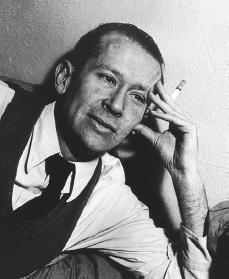
“…poetry is not to be explained, but to be enjoyed.”
– E.E. Cummings
03 Sunday May 2015
Posted in EE Cummings
One of the greatest meditations on what art is and isn’t, on the pleasures and perils of the creative life, comes from E.E. Cummings, whose lesser-known prose enchants very differently and yet by the same mechanism that his celebrated poetry does — by inviting the reader to “pick his way toward comprehension, which comes, when it does, in a burst of delight and recognition.”
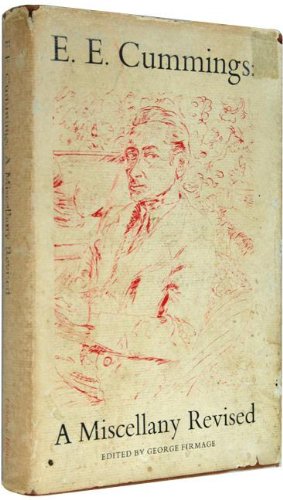
E. E. Cummings: A Miscellany Revised is, sadly, out of print — but it’s well worth the hunt. Complement it with Susan Cheever’s biography of Cummings and the unusual story of the fairy tales he wrote for his only daughter,
Thanks to Maria Popova and her amazing weekly newsletter: Brain Pickings. If you love books, you must read her pages.
01 Friday May 2015
Posted in EE Cummings, Events, Music, Poetry, Silver Lake
The Friends of Madison Library open the window on E.E. Cummings at Silver Lake with a Weekend of Celebration.
Join us for a weekend of art, music, poetry and history exploring the relationship between the American poet and artist, E E Cummings, and the people and town of Madison, New Hampshire. Friday night will feature a “nonlecture”, art show, Cummings’ poetry set to music and discussion. On Saturday visit 8 local sites, including the Cummings’ Family Collection at the Madison Historical Society and the poets’ beloved “Joy Farm”.
Tickets include both the Friday night events and the Saturday tour. Box lunches will be available for sale at the Madison Library on Saturday. Tickets are $20 per person or $15 if purchased before June 30, 2015. All proceeds benefit the non-profit Friends of Madison Library.
Joy Farm will host an afternoon tea with limited seating by separate additional ticket purchased in advance. Tickets for the tea are an additional $10.
29 Wednesday Apr 2015
Posted in EE Cummings, Joy Farm, Painting
Tags
Best known as a poet, E.E. Cummings was also an accomplished artist. While his early work was often abstract, later in his life he frequently painted the view of the mountains from Joy Farm. “Many of the landscapes are either weirdly surreal and muted or else bursting with mad swirls of brilliant colors. His favorite (or at least most frequent) landscape subject by far was Mt Chocorua in the White Mountains of New Hampshire, which often either dominates the canvas or at least makes its presence known (á la Mt Fuji in traditional Japanese painting).” quote from Ken Lopez Bookseller.
In a “conversation” with himself, Cummings’ compares his paintings with his poetry.
“Your poems are rather hard to understand, whereas your paintings are so easy.
Easy?
Of course—you paint flowers and girls and sunsets; things that everybody understands.
I never met him.
Who?
Everybody.
Did you ever hear of nonrepresentational painting?
I am.
Pardon me?
I am a painter, and painting is nonrepresentational.
Not all painting.
No: housepainting is representational.
And what does a housepainter represent?
Ten dollars an hour.
In other words, you don’t want to be serious—
It takes two to be serious.
E.E. Cummings in “Forward to an Exhibit: II” (1945)
25 Saturday Apr 2015
Posted in EE Cummings, Music, Poetry
E.E. Cummings, the poet of the “little i”, was also a poet of the EYE.
According to Billy Collins, himself a poet, Cummings broke “down words into syllables and letters”, employed eccentric punctuation”, and indulged “in all kinds of print-based shenanigans”.
Famously, Cummings wrote, “not all my poems are to be read aloud-some are to be seen and not heard.”
And, some were clearly must be sung, as Natalie Merchant sings maggie and millie and molly and may.
24 Friday Apr 2015
Posted in EE Cummings, Poetry
Tags
in Just-
spring when the world is mud-
luscious the little
lame balloonman
whistles far and wee
and eddieandbill come
running from marbles and
piracies and it’s
spring
when the world is puddle-wonderful
the queer
old balloonman whistles
far and wee
and bettyandisbel come dancing
from hop-scotch and jump-rope and
it’s
spring
and
the
goat-footed
balloonMan whistles
far
and
wee
(E.E. Cummings Complete Poems 27)

“Maybe he had a mental problem”, said Becky, an eighth grader, on her first time reading “in Just-“. So begins a wonderful article by Audri L. Wood describing her classroom teaching Cummings’ poetry to adolescents.
“Fifteen minutes later…the entire class had dissected every potential meaning from every line, every space (or lack thereof), every word. Fifteen minutes of discussion. Fifteen minutes of asking why he didn’t have to follow preset formats for sonnets, haiku, and the like. Fifteen minutes of examining how they had written poetry, how they had manipulated spacing, capitalization, and words. Fifteen minutes of memories exploded, of breathless voices of running children, of the sounds of shoes pounding the pavement during hopscotch and the smacking of the jump-rope, of inseparable friends, and of the passing notice and constant awareness of adults being present and of their whistles, reminding you that it is not just a dream, that it is spring.”
(From Spring The Journal of the E.E. Cummings Society, New Series Number 6, 1997.)
 Cummings at Silver Lake